
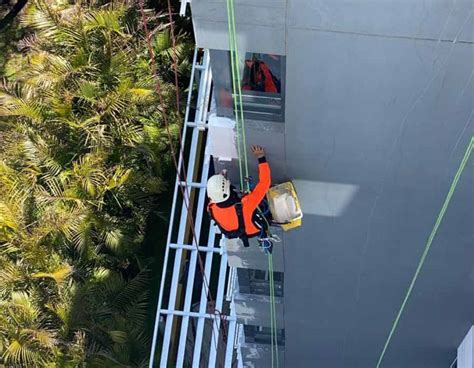
Repairing defects on a multi-storey building can be complicated before the repair itself even begins. Technicians need safe access to façades, balconies, roofs and other elevated areas, while building occupants, pedestrians and surrounding property may need to remain protected throughout the work.
Rope access remedial repairs can provide an alternative to scaffolding, elevated work platforms and other access methods for suitable projects. However, rope access should not automatically be considered the cheapest, fastest or safest option. Its suitability depends on the building, repair scope, access requirements and risks involved.
What Are Rope Access Remedial Repairs?
Rope access uses specialised rope systems and equipment to position trained technicians at difficult-to-reach work locations.
The technique can potentially be used for inspection, maintenance and selected repair tasks where conventional access is difficult or would require substantial temporary infrastructure.
Depending on the building and scope, remedial work may include:
- Façade inspections
- Crack repairs
- Sealant replacement
- Concrete patch repairs
- Waterproofing-related work
- Painting and coating applications
- Replacement of selected façade components
- Leak investigation
- Maintenance around elevated building elements
The appropriate repair method still needs to be determined independently of the access method.
Access Should Follow the Repair Strategy
A common mistake is deciding to use rope access before establishing what is actually wrong with the building.
The defect should be investigated first. Cracking, water ingress, deteriorating concrete and failed sealants can have different underlying causes, and simply repairing the visible symptom may provide only a temporary result.
A suitable process generally involves identifying the defect, determining its likely cause, establishing the required repair and then selecting an access method capable of supporting that work safely.
When Can Rope Access Be Useful?
Rope access can be particularly practical where work is localised across a façade or where scaffolding would be disproportionately extensive for the repair area.
Because large temporary access structures may not be required, the approach can sometimes reduce the physical footprint of the project.
This can be valuable around buildings where maintaining pedestrian routes, entrances or normal operations is important.
However, whether these advantages translate into lower costs or shorter project times depends on the individual job. Extensive repairs requiring large quantities of materials or repeated access to the same broad area may favour another method.
Not Every Repair Is Suitable for Rope Access
There are practical limits to what technicians can safely and efficiently accomplish while suspended or positioned using rope systems.
Projects involving heavy materials, extensive demolition, substantial equipment or large continuous work areas may require scaffolding, elevated work platforms or other engineered access solutions.
Weather can also affect operations. Strong winds, rain, extreme conditions and other environmental factors may make work unsuitable at particular times.
A site-specific assessment should determine whether rope access remedial repairs are appropriate rather than relying on the building’s height alone.
Safety Requires More Than Technician Training
Rope access work involves significant risks and requires appropriately trained and competent personnel, suitable equipment and carefully planned systems of work.
Planning should address matters such as:
- Anchor systems
- Rope configurations
- Equipment inspection
- Safe access and egress
- Falling-object controls
- Exclusion zones
- Weather conditions
- Communication
- Emergency procedures
- Rescue arrangements
People at ground level also need protection. Tools, repair materials and loose building components can present hazards if dropped from height.
Façade Repairs Need Proper Diagnosis
Visible façade deterioration can sometimes indicate a deeper problem.
For example, cracking in concrete may be associated with movement, reinforcement corrosion or other conditions. Failed sealants may allow water penetration, but simply applying additional sealant without addressing the underlying joint condition may not provide an effective long-term repair.
Where structural or significant building defects are suspected, assessment by an appropriately qualified professional may be required.
Rope access provides a way of reaching the defect; it does not replace engineering, waterproofing or other specialist expertise.
Waterproofing and Leak Repairs Need Careful Investigation
Water ingress can be particularly difficult to diagnose because the point where moisture becomes visible indoors may not be where water enters the building.
Rope access can enable technicians to inspect external joints, penetrations, façade elements and other difficult locations. It may also provide access for selected remedial works once the source has been appropriately identified.
However, repeated spot repairs without understanding the moisture pathway can result in recurring problems.
Consider Occupants and the Public
One advantage of rope access is that it may require less ground-level infrastructure than extensive scaffolding, but disruption cannot be assumed to disappear entirely.
Exclusion areas may still be required, and access around entrances, footpaths or balconies may need temporary controls.
Noise, dust, debris and coatings can also affect occupants depending on the repair activity.
Project planning should therefore consider both the technicians working at height and everyone using the areas below or adjacent to the work.
Documentation Matters
Remedial work should be documented so building owners and managers understand what was inspected and repaired.
Depending on the project, useful records can include photographs, defect locations, repair methods, materials used and recommendations for future monitoring.
Before-and-after photographs can be particularly useful when work occurs on areas that property managers cannot easily inspect from ground level.
Compare Access Methods Before Proceeding
Before selecting rope access remedial repairs, compare the available approaches according to the actual project.
Important considerations include:
- Repair area and duration
- Building geometry
- Material and equipment requirements
- Access restrictions
- Safety risks
- Occupant disruption
- Public protection
- Weather exposure
- Total project cost
Rope access can be an efficient solution where the work and building are suited to it. Its value comes from selecting it for the right application—not from treating it as a universal replacement for scaffolding or other access systems.
Frequently Asked Questions
Is rope access always cheaper than scaffolding?
No. Costs depend on the scope, duration, building configuration and equipment required. Each project should be assessed individually.
What repairs can be completed using rope access?
Potential applications include selected façade, concrete, sealant, coating and waterproofing repairs, provided the work can be performed safely using the access system.
Can rope access be used on every high-rise building?
Not necessarily. Building geometry, anchor arrangements, repair requirements and site conditions all influence suitability.
Can rope access technicians diagnose structural defects?
Rope access technicians can facilitate close inspection, but structural assessment should be undertaken by appropriately qualified professionals where required.
Can rope access work continue during bad weather?
Weather conditions can affect safety. Work should proceed only when conditions remain within the requirements of the planned system of work.


